We Can't Breathe by Jabari Asim
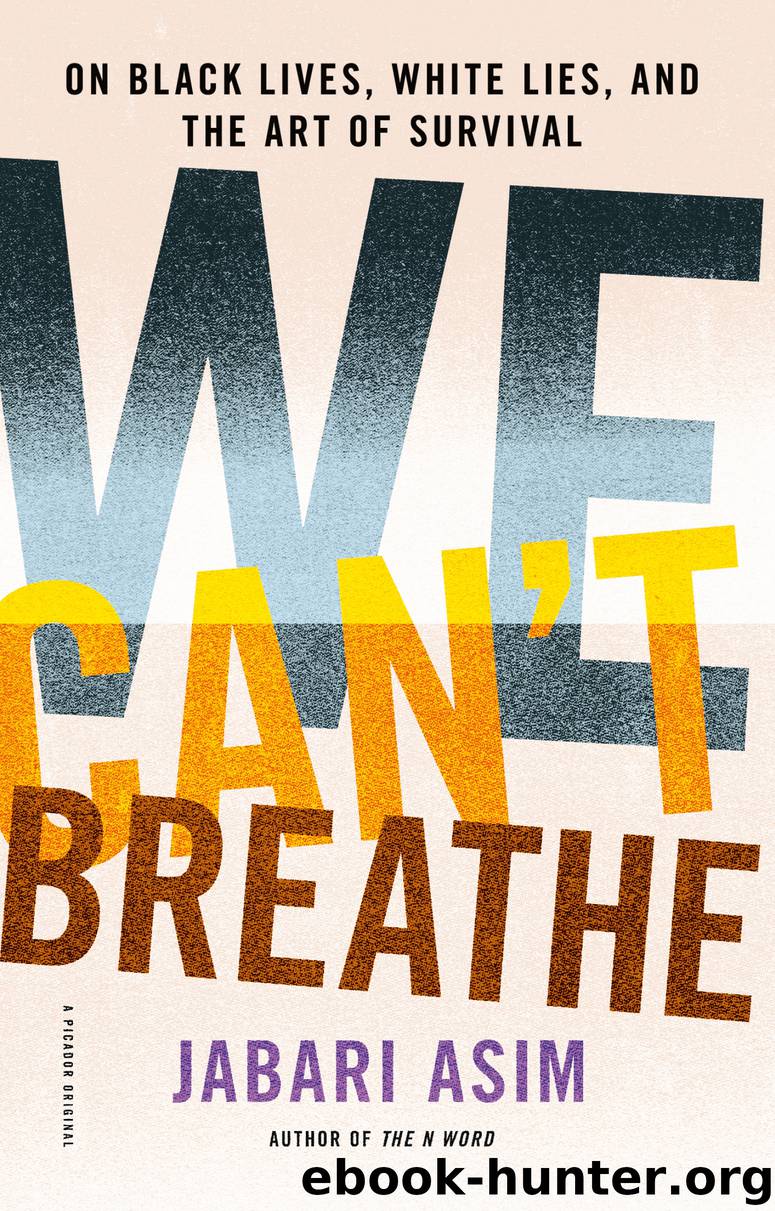
Author:Jabari Asim
Language: eng
Format: epub
Publisher: Picador
All
worship the Wall.
—Gwendolyn Brooks, “The Wall”
BRICK RELICS
My wife, Liana, and I were driving through Medford, Massachusetts, on our way back to our home just outside Boston. Looking out the passenger window, I saw a low brick wall, short, straight, and parallel to the road. I thought little of it until I saw a sign that read “The Slave Wall.” We drove by so quickly that I wasn’t sure exactly what I’d seen. After we got home, I typed “slave wall” and “Medford” into an online search engine.
* * *
My writing practice normally involves plastering the walls around me with layers of paper, each splattered with simple sketches, stick figures, and nearly indecipherable scribbles. But, the wall in my new space is made of exposed brick; pushpins are impossible, and tape fares almost as poorly. The adhesive tries and fails to sustain a connection; sheets of paper curl and slide slowly to the floor like the last leaves of the season. Unfazed by these difficulties, I downloaded a color photograph of the wall I’d seen. I applied tape to the corners and pressed it to the bricks.
* * *
In the photograph, the wall looks about three feet high and twenty feet long. Its surface is so weathered that the individual bricks are no longer detectable in some places, obscured by white sediment or mortar crumbled to dust. It looks sturdy nonetheless, able to withstand wind, rain and, as it turned out, 250 years of history.
* * *
A man named Pomp built the wall in 1765. He was one of forty-nine enslaved black people in town at the time, according to the Medford Historical Society.
* * *
Medford was once the brickmaking capital of the Northeast. The area was rich in clay, the main ingredient, and brickyards sprang up to supply the bustling market in Boston and other New England towns. The industry was more than one hundred years old by the time Pomp set to work with his string line and trowels. Some of the town’s most prominent citizens had stakes in the business, including members of the Tufts, Blanchard, Bradshaw, and Brooks families.
* * *
It was the Brooks tribe that pressed Pomp’s bricklaying skills into service. At the bidding of his captor Thomas Brooks, he built the wall to mark the edge of the family’s estate. I imagine Pomp kneeling with his tools, surveying the site while above him Brooks explains the project to a fellow capitalist. Everyone should know where one man’s property ends and another’s begins, I hear him say.
* * *
“Runagate Runagate,” Robert Hayden’s immortal poem, begins as a breathless sprint. It follows a group of runaways as they navigate by the stars and pursue freedom via the Underground Railroad. They flee “from darkness into darkness,” away from hunters, hounds, and posters calling for their flesh.
If you see my Pompey, 30 yrs of age,
new breeches, plain stockings, negro shoes;
More than five thousand black people were held captive in Massachusetts when Pomp built his wall. Did he ever dream
Download
This site does not store any files on its server. We only index and link to content provided by other sites. Please contact the content providers to delete copyright contents if any and email us, we'll remove relevant links or contents immediately.
| Anthropology | Archaeology |
| Philosophy | Politics & Government |
| Social Sciences | Sociology |
| Women's Studies |
Cecilia; Or, Memoirs of an Heiress — Volume 1 by Fanny Burney(32558)
The Great Music City by Andrea Baker(32019)
Cecilia; Or, Memoirs of an Heiress — Volume 2 by Fanny Burney(31956)
Cecilia; Or, Memoirs of an Heiress — Volume 3 by Fanny Burney(31942)
We're Going to Need More Wine by Gabrielle Union(19046)
All the Missing Girls by Megan Miranda(16029)
Pimp by Iceberg Slim(14508)
For the Love of Europe by Rick Steves(14121)
Bombshells: Glamour Girls of a Lifetime by Sullivan Steve(14077)
Talking to Strangers by Malcolm Gladwell(13370)
Norse Mythology by Gaiman Neil(13367)
Fifty Shades Freed by E L James(13243)
Mindhunter: Inside the FBI's Elite Serial Crime Unit by John E. Douglas & Mark Olshaker(9344)
Crazy Rich Asians by Kevin Kwan(9292)
The Lost Art of Listening by Michael P. Nichols(7506)
Enlightenment Now: The Case for Reason, Science, Humanism, and Progress by Steven Pinker(7314)
The Four Agreements by Don Miguel Ruiz(6765)
Bad Blood by John Carreyrou(6622)
Weapons of Math Destruction by Cathy O'Neil(6281)
